
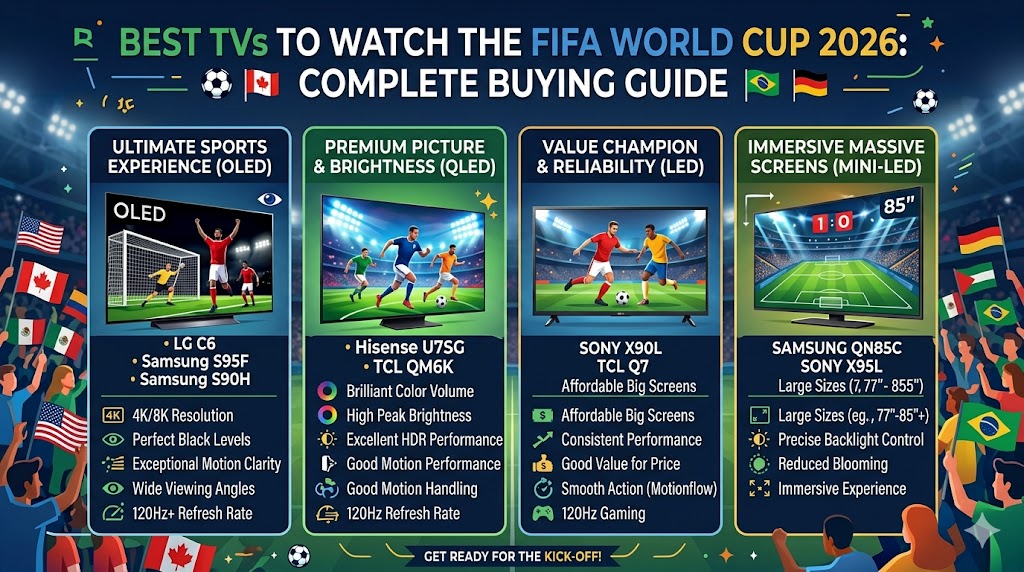
Updated 21 July 2026. The tournament is done. Spain beat Argentina 1–0 in extra time at New York New Jersey Stadium on 19 July, Ferran Torres scoring in the 106th minute to hand Spain their second title. Forty-eight teams, 104 matches, sixteen host cities across three countries — the largest World Cup ever staged, and now finished.
Which puts anyone shopping for the best TV to watch World Cup 2026 football in an unexpectedly good position. Tournament-season demand has evaporated, retailers are sitting on inventory they ordered for June, and the 2025 flagship panels have been marked down to clear space for the 2026 range. If you watched the final on a set that struggled with fast camera pans, the next few weeks are the cheapest window you will get before Black Friday.
This guide has been rebuilt with verified current pricing and corrected model information. Two of the picks in the previous version carried errors we have fixed and flagged below.
What we corrected in this update
Buying guides age badly, and this one aged in two specific places:
- The TCL QM6K is a 2025 model, not a 2026 one. It launched at CES 2025. That does not make it a bad buy — it makes it a better one, because it is now deeply discounted. But the model year matters when you are comparing spec sheets.
- The Samsung flagship was mislabelled. Samsung’s 2026 flagship OLED is the S95H, not the S90H. The previous version mixed the two sets’ names, prices, and processor generations together. Both are covered correctly below.
- Prices have been re-checked against manufacturer and retailer listings in July 2026 rather than carried over from launch announcements.
What actually matters in a TV for watching football
Not every number on a spec sheet translates into a better match. These are the four that do.
Motion handling, not just refresh rate
A 120Hz panel is the practical floor. Broadcast football is delivered at 50 or 60 frames per second, so a 165Hz panel is not showing you more frames of the match — what it buys you is headroom, and more importantly, it tends to come attached to better motion processing silicon.
That processing is the part that matters. A camera panning to follow a winger down the touchline is the single hardest thing a TV has to do, and cheap sets smear it. If you can see a set in a shop, ask for live sport rather than the demo reel.
Brightness and glare, especially for daytime kick-offs
Anti-reflective coating has quietly become the most important feature for sports viewing, and it is the one buyers most often overlook. A stunning OLED in a sunlit room with a glossy panel will look worse than a mid-range Mini-LED with a good matte finish.
Mini-LED achieves brightness through local dimming across thousands of zones. OLED achieves contrast through per-pixel light control. Both work for football. The deciding factor is usually your room, not the panel technology.
Viewing angle is the watch-party spec
This is the most underrated line on any spec sheet. Budget VA-panel LED sets wash out visibly from around 30 to 40 degrees off-axis. OLED holds colour and contrast well past 60 degrees. If anyone is going to be sitting on the arm of the sofa or perched sideways in a kitchen chair, this decides whether they see the same match you do.
Screen size versus seating distance
For one or two people sitting eight to ten feet back, 55 to 65 inches is the sweet spot. For a group, go to 75 inches or larger. A rough rule: divide your seating distance in inches by 1.6 to get a sensible screen size. A ten-foot sofa distance works out to roughly 75 inches.
The price gap between 65 and 75 inches has narrowed sharply in 2026. If you are hesitating between the two, size up.
The 5 best TVs for watching football in 2026
Prices below are manufacturer MSRP with current street pricing noted where it differs meaningfully. Post-tournament discounting is active, so check the live price before buying.
1. Best budget pick — TCL QM6K QD-Mini LED
MSRP: $799 (55-inch), $999 (65-inch), $1,299 (75-inch) — now widely discounted well below these figures | Check price on Amazon
| Spec | Detail |
|---|---|
| Panel type | QD-Mini LED |
| Model year | 2025 (still widely stocked) |
| Screen sizes | 50″, 55″, 65″, 75″, 85″, 98″ |
| Refresh rate | 144Hz native |
| HDR support | HDR10, HDR10+, Dolby Vision |
| Smart platform | Google TV |
| Audio | Onkyo 2.1 |
The QM6K is a 2025 set, and that is precisely why it belongs here. TCL brought QD-Mini LED down to a price point that used to buy you a basic edge-lit panel, and a year into its life the discounting has become genuinely aggressive — the 75-inch has been seen under $750 and the 98-inch has dropped below $1,800 from a $3,499 launch price.
For football, the Mini-LED backlight with local dimming is the meaningful upgrade over conventional budget LED. Floodlights against a dark crowd, night kick-offs, the specific green of a floodlit pitch — all of it holds up better than the price suggests. The 144Hz panel handles the pace fine.
Two known weaknesses. The built-in audio is mediocre, and glare handling is the weakest of anything here. Budget for a soundbar, and if your room gets strong afternoon light, step up to the Hisense instead.
Best for: controlled-lighting rooms, first TVs, anyone who wants Mini-LED contrast for the least money.
2. Best mid-range pick — Hisense U7SG Mini-LED
MSRP: $1,299 (55-inch), $1,499 (65-inch), $2,499 (75-inch) | Check price on Amazon
| Spec | Detail |
|---|---|
| Panel type | Hi-QLED Mini-LED Pro, full-array local dimming |
| Model year | 2026 |
| Screen sizes | 55″ to 116″ |
| Refresh rate | Native 165Hz |
| Processor | Hi-View AI Engine Pro |
| Audio | 50W 2.1.2 Dolby Atmos |
| Smart platform | Google TV (U7SG) or Fire TV (U7SF) |
This is the pick we would give most people buying specifically for sport. Hisense has pushed features down from its flagship tier into the U7 for 2026, and the one that matters most here is the anti-reflection and glare-free coating — technology that until recently only appeared on sets costing three times as much.
If you watch afternoon or early-evening matches in a room with windows, that coating will do more for your picture than any other single spec on this page. It is the reason this set beats the cheaper TCL for most buyers.
The 50W 2.1.2 Dolby Atmos speaker array is also unusually capable for the money. It will not replace a proper soundbar setup, but for a group of four to six it carries crowd noise and commentary without the thin, boxy quality typical of flat-panel audio.
The SG and SF variants share the same panel, refresh rate, and processor. The only difference is the smart platform: Google TV versus Fire TV. Pick whichever ecosystem you already use.
Best for: bright living rooms, watch parties of four to eight, buyers who want near-flagship performance without OLED pricing.
3. Best value OLED — LG C6 (2026)
MSRP: $1,399 (42-inch) to $5,299 (83-inch); $2,699 for the 65-inch, with street pricing already near $1,999 | Check price on Amazon
| Spec | Detail |
|---|---|
| Panel type | OLED evo (WRGB); RGB Tandem on 77″ and 83″ C6H |
| Screen sizes | 42″, 48″, 55″, 65″, 77″, 83″ |
| Processor | Alpha 11 AI Gen 3 |
| HDR support | Dolby Vision IQ, HDR10, HLG |
| HDMI ports | 4x HDMI 2.1 |
| Smart platform | webOS 26 with Google Gemini and Microsoft Copilot |
The C-Series has been the default recommendation for everyday OLED buyers for years, and the C6 does not break that streak. It launched in March 2026 at the same US pricing the C5 launched at, and it has already fallen well below MSRP at major retailers.
One detail worth knowing before you buy: the 77-inch and 83-inch models are sold as the C6H and use a second-generation four-layer RGB Tandem OLED panel that is significantly brighter than the rest of the range. The 42- through 65-inch models use the standard OLED evo panel. If you are buying at 65 inches or below, you are getting last year’s panel with a better processor — still excellent, but not the headline upgrade.
For football, OLED’s advantage is viewing angle and per-pixel black level. Nobody in the room gets a washed-out picture. The processor upgrade also improves upscaling of 1080p broadcast feeds, which matters more than people expect, since plenty of football still arrives at 1080p even on premium streaming tiers. What Hi-Fi tested the C6 directly against the C5 and found real gains in brightness and refinement.
Best for: first-time OLED buyers, groups seated at angles, anyone who wants the best all-round picture below flagship money.
4. Best premium value — Samsung S95F QD-OLED (2025 flagship, now discounted)
MSRP: $2,499 (55-inch), $3,499 (65-inch), $4,499 (77-inch) — discounted since the S95H replaced it | Check price on Amazon
| Spec | Detail |
|---|---|
| Panel type | QD-OLED |
| Screen sizes | 55″, 65″, 77″ |
| Refresh rate | 165Hz (Motion Xcelerator) |
| Processor | NQ4 AI Gen3 |
| Anti-glare | Glare Free matte coating |
| Dolby Vision | No — HDR10+ and OLED HDR Pro instead |
The S95F was Samsung’s 2025 flagship. The S95H has taken that slot for 2026, which means the S95F is now the best-value premium OLED on the market — it lost nothing in picture quality, only its position in the catalogue.
Two things make it excellent for football. The Glare Free matte finish is among the best anti-reflection surfaces available, so afternoon matches in a sunlit room look dramatically better than they would on a glossy panel. And QD-OLED produces unusually saturated colour: pitch green, kit contrast, and the red and yellow of a card all land with real vibrancy.
The omission is Dolby Vision. Samsung uses HDR10+ and its own OLED HDR Pro instead. For football this is a non-issue, since sports broadcasts almost universally arrive in HDR10 or HLG regardless of platform.
Best for: buyers who want flagship picture quality at a discount, bright rooms, existing Samsung ecosystem owners.
5. Best 2026 OLED for bright rooms — Samsung S90H
MSRP: $1,399 (42-inch) rising to $5,299 (83-inch); the 65-inch lists at $2,699 with street pricing near $1,999 | Check price on Amazon
| Spec | Detail |
|---|---|
| Panel type | WRGB OLED (changed from QD-OLED for 2026) |
| Screen sizes | 42″, 48″, 55″, 65″, 77″, 83″ |
| Refresh rate | Motion Xcelerator 165Hz |
| Processor | NQ4 AI Gen3 |
| Anti-glare | Glare Free — new to this tier for 2026 |
| Gaming | NVIDIA G-SYNC, AMD FreeSync Premium Pro |
To be clear about the lineup: Samsung’s 2026 flagship OLED is the S95H, which starts at $2,499 for the 55-inch and reaches $6,499 at 83 inches, adds the new FloatLayer wall-mount design, and is roughly 35% brighter than the S95F. It is the best set Samsung makes.
The S90H is the one we would actually buy for football. Glare Free technology has been extended down to this tier for the first time, it now runs at 165Hz, and independent measurement of the 65-inch put it around 2,450 nits on small HDR windows while covering 127% of DCI-P3 — wider colour coverage than the flagship. At roughly $700 less than the equivalent S95H, that is a lot of set for the money.
One genuine change to be aware of: for 2026 the S90 series moved from QD-OLED to WRGB OLED panels across the range. Previous S90 models mixed the two depending on size and region. If you specifically wanted a cut-price QD-OLED, the S95F above is now the way to get one.
Best for: bright living rooms, buyers who want current-generation Samsung OLED without flagship pricing.
Best TV to watch World Cup 2026 football: quick comparison
| TV | Panel | Best for | Sizes | From |
|---|---|---|---|---|
| TCL QM6K | QD-Mini LED | Budget, controlled lighting | 50″–98″ | $799 MSRP, heavily discounted |
| Hisense U7SG | Hi-QLED Mini-LED Pro | Bright rooms, watch parties | 55″–116″ | $1,299 |
| LG C6 | OLED evo / RGB Tandem | Best all-round OLED value | 42″–83″ | $1,399 |
| Samsung S95F | QD-OLED | Premium picture at a discount | 55″–77″ | $2,499 MSRP, now lower |
| Samsung S90H | WRGB OLED | Current-gen OLED, bright rooms | 42″–83″ | $1,399 |
Where to watch football now the tournament is over
Fox and FS1 held exclusive English-language rights to all 104 matches in the United States, with Telemundo and Peacock carrying Spanish-language coverage. Fox One, Fox’s own streaming service at $19.99 per month, carried every game and still hosts full-match replays and highlights.
If you subscribed to a live TV package purely for the tournament, now is the moment to review it. YouTube TV, Fubo, Hulu + Live TV, and Sling all run between roughly $46 and $83 per month, and those charges continue whether you are watching or not.
Looking ahead, the European club season restarts in August and runs through May, the Champions League group stage begins in September, and MLS is mid-season now. Check which service carries the competitions you actually follow before renewing anything — rights have shifted considerably in the last two years.
For results, standings, and archive coverage from the tournament, worldcupwatch.live maintains verified match data and group tables.
Five TV settings to change before the next match
Even an excellent TV underperforms out of the box. These five adjustments take about ten minutes.
- Switch to Sports mode, not Cinema or Movie. Sports presets tune motion processing for fast horizontal camera movement, which is exactly what football demands. Movie mode’s smoothing produces the soap-opera effect that ruins film but does nothing useful for a pan down the wing.
- Turn off Energy Saving. Many sets ship with eco modes that cap peak brightness. For evening matches you want the full range available.
- Drop Sharpness to 0. Factory sharpness is almost always too aggressive, adding artificial edge enhancement that makes faces and turf look processed. Zero is the correct starting point on most panels.
- Enable Game Mode only for console streaming. If you watch through a PS5 or Xbox app, Game Mode roughly halves input lag without harming video quality. Leave it off for the TV’s own apps.
- Set Backlight or OLED Light for your actual room. Maximum in daylight, considerably lower in a dark room. Over ninety minutes this is the single biggest comfort difference you can make.
If your room is large enough that even an 83-inch panel feels small, a laser projector will get you to 120 inches for less than a flagship OLED costs — our projector versus TV comparison covers where each one wins.
Frequently asked questions
What is the best TV to watch World Cup 2026 highlights and replays on now? For most people, the Hisense U7SG at $1,299. Its anti-glare coating and native 165Hz panel handle both daytime viewing and fast motion, and it costs a fraction of a flagship OLED. If budget is tighter, the discounted TCL QM6K is the value pick.
Is it worth buying a TV now the tournament has ended? Yes. Post-tournament inventory clearing and the 2025-to-2026 model changeover have pushed prices to their lowest point of the year outside Black Friday. The 2025 flagships in particular — the Samsung S95F especially — are excellent value right now.
Is OLED or Mini-LED better for football? Both work. Mini-LED sets like the Hisense U7SG go brighter and cope better with daylight. OLED sets like the LG C6 have far better viewing angles and per-pixel contrast, which matters when people are seated across a room. Dark room and a premium budget favours OLED; bright room with guests everywhere favours high-end Mini-LED.
Do I need 165Hz, or is 120Hz enough? 120Hz is plenty for broadcast football, which is delivered at 50 or 60 frames per second. Higher refresh rates matter for console and PC gaming, not for live sport. Do not pay a premium for 165Hz if the TV is only for watching.
Is the TCL QM6K a 2026 model? No. It launched at CES 2025 and is a 2025 model, though it remains widely stocked. That is why it is discounted, and why it is still a strong budget recommendation — just be aware of the model year when comparing it against 2026 sets.
What is Samsung’s actual 2026 flagship OLED? The S95H, priced from $2,499 for the 55-inch up to $6,499 for the 83-inch. The S90H sits below it and the S85H below that. For football specifically, the S90H offers most of the benefit for meaningfully less money.
What screen size should I buy? Divide your seating distance in inches by 1.6. Eight feet works out to roughly 60 inches, ten feet to about 75. For groups, size up rather than down — the price gap between 65 and 75 inches is smaller in 2026 than it has ever been.